Since it has been a while since I posted, I thought I'd post about the four bikes I got cleaned and fixed up.
Old Murray bike from 1940s or 1950s before cleaning.
This Murray took me the longest to clean. I believe this bike was made in the 1950s or 1940s and it is very heavy. I scrubbed the crusty old tires and seat with Tuff Stuff and Scotch Bright pads. I washed the frame with Dawn and water to remove the loose dust and grease. The rims and fenders were cleaned with aluminum foil to remove most of the rust. The rims were also cleaned using a toothbrush and Bar Keeper's Friend before remounting the tires. I sprayed the whole bike with wax since it has a coaster break in the rear wheel.
After cleaning.
After I was finnished with the Murray, I started working on this Mongoose Threshold from the 1990s.
1990s Mongoose Threshold.
This bike needed to be cleaned and the breaks needed aligned. First, I cleaned the frame, handle bars, and fork with Tuff Stuff. Next, I removed the wheels and scrubbed the tires with Tuff Stuff and a brush. After that, I waxed the tires and frame, Lastly, I sanded the rims and brake pads with 220 grit sandpaper to remove the wax prior to re-installing the wheels.
After cleaning.
Since It's late and need to go to bed, I will follow up with the last two tomorrow.
Yesterday, I was riding home from Towne Drugs and someone in a black SUV yelled at me saying I should be on the sidewalk. It was on Western Ave. between 3rd S. and 4th St. As annoying to cyclists as they are, there is a reason for having stop signs at every intersection. Their purpose is to discourage through traffic. This self-entitled motorist was clearly through traffic. He drive the entire length of Western Ave. just to turn right onto 5th St. and left onto Center Ave. I yelled, "Why don't you stay on f***ing Freeport Rd.! another block!" As far as I know, there is only one stop sign in one direction the entire length of Freeport Rd. which is about 20 miles, while Western Ave. has four stop signs in both directions. The whole street is 1/4 mile long. Why do these imbeciles insist on cutting through a neighborhood with narrow, stop sign filled streets so they can endanger myself and my neighbors. If he was in such a hurry, he should have stayed on Freeport Rd., one more block and turning left directly onto Center Ave. Parking is banned on the western side of Center Ave. so there is more room to maneuver around cyclists. We seriously need more enforcement of this stuff as well as education so the people will stop harassing other people who are fulfilling their transportation needs.
Here are some pictures of my bike as well as another bike I was working on at Kraynick's today.
First, My bike. Isn't she sexy? She is a custom bike with Cannondale aluminum frame and steel fork and crankset
from an old Raleigh Technium. The paint has been stripped from the frame
and fork. The fork has been spraypainted with black gloss automotive enamel and the frame was sanded and polished.
Entire bike shot.
Close up of the saddle, rear brake, rear tire, seat tube and seat stay.
Close up of the handlebars and top tube.
Close up of the crankset, rear wheel, derailleurs, and down tube.
Next, the Chrome stainless steel Diamondback that I cleaned up today.
Entire bike shot.
Both bikes together.
I think both of these bikes are beautiful, but I am biased toward the one on the right because I built it. Personally, I never thought aluminum can be as shiny chrome stainless steel. Can you tell the difference?
Unfortunately, I was hit by a car two Saturdays ago as I was on my way to Hazelwood from Kraynick's. I did not really get hurt from this incident. Last Friday, I crash-landed on Freeport Rd. at Lexington Ave. This really hurt as I severely sprained my right foot and left shoulder. I went to the emergency room to days later, and they confirmed that no bones were fractured or broken. There was no organ damage, and I am over 90% heeled.
I used an old Cannondale aluminum road bike frame. The crankset, derailleurs, shifters, peddles, stem, headset, seat, and seat post are from an old Raleigh that one of the chainstays was cracked. The handlebars are a used pair of flat bars from the shop. The fork is original to the Cannondale frame. The brake levers, chain, wheels, and tires are all new.
Cannondale frame.
First, I tried to burn the paint off of the frame with a propane torch, but that did not work as you can see in this video.
Since I was unable to burn off the paint, I decided to sand it all off with sixty grit sandpaper. When I was done sanding, I took the fork home and used paint stripper to remove the gray paint from it. Since the fork is made of steel, I used black Rust-Oleum Automotive Enamel gloss spray paint to paint it.
I continued to sand the bare aluminum with finer and finer sandpaper up to 500 grit and gave it a final cleaning with Bar Keeper's Friend.
Frame after sanding.
After all the cleaning was done, Rocky installed the bottom bracket and crankset from the old Raleigh. Carl and I installed the derailleurs, shifters, brakes, and associated cables. Today, Daniel, Rocky and I got everything finalized, and I paid for the parts.
It turned out that the aluminum color with black are a very nice color combination. I also like that I do not have to shift it as much as my Fuji hybrid that I have been riding for the past several several months. It is also a lot lighter as I can grab it with one hand and carry it up the city steps in Morningside on my way to the shop instead of wrestling the Fuji with both hands. I think it is very beautiful and am starting to become emotionally attached to it.
Pittsburgh has the most public staircases of any city in the United States. The original purpose of these steps was so that factory workers could walk from their home up on the hill to their job in the river valley. As the steel mills closed and more people had cars, many of these staircases have developed cracks in their steps and weed start growing from the cracks and encroach on the public right of way. Today, I took some photographs of four staircases in Morningside.
Adelphia St.
Looking up the Adelphia St. Steps.
These well-maintained wooden steps actually serve as the street that the two houses at the top are on. Take note of the street sign on the telephone pole at the bottom.
looking down the Adelphia St. Steps.
Houses located on the steps.
Martha St.
Oh, do these steps come in handy. The Martha St. steps start out as a jumpwalk on the northern edge of Martha St. at Morningside Ave. Upon crossing Duffield St., the road disappears, but the steps continue up the hill to El Paso St. in Stanton Heights where the road reappears. Martha St. continues one more block to Trinity St. These steps link northeastern Stanton Heights with Morningside and provide pedestrian access to bus service on Jancey St. and Chislett St. as well as the Morningside business bistrict.
Near the bottom of the Martha St. steps.
Looking across Duffield St.
Looking down the steps.
Gallatin St.
The Gallatin St. steps provide residents near Witherspoon St. access to bus stops located on Baker St. The steps also provide lower Morningside residents pedestrian access to the Morningside business district.
Bottom of Gallatin St. steps showing a bus stop.
Top of Gallatin St. Steps at Witherspoon St.
Jancey St.
Looking across the Allegheny River into Sharpsburg.
This house is only accessible from the Jancey St. steps.
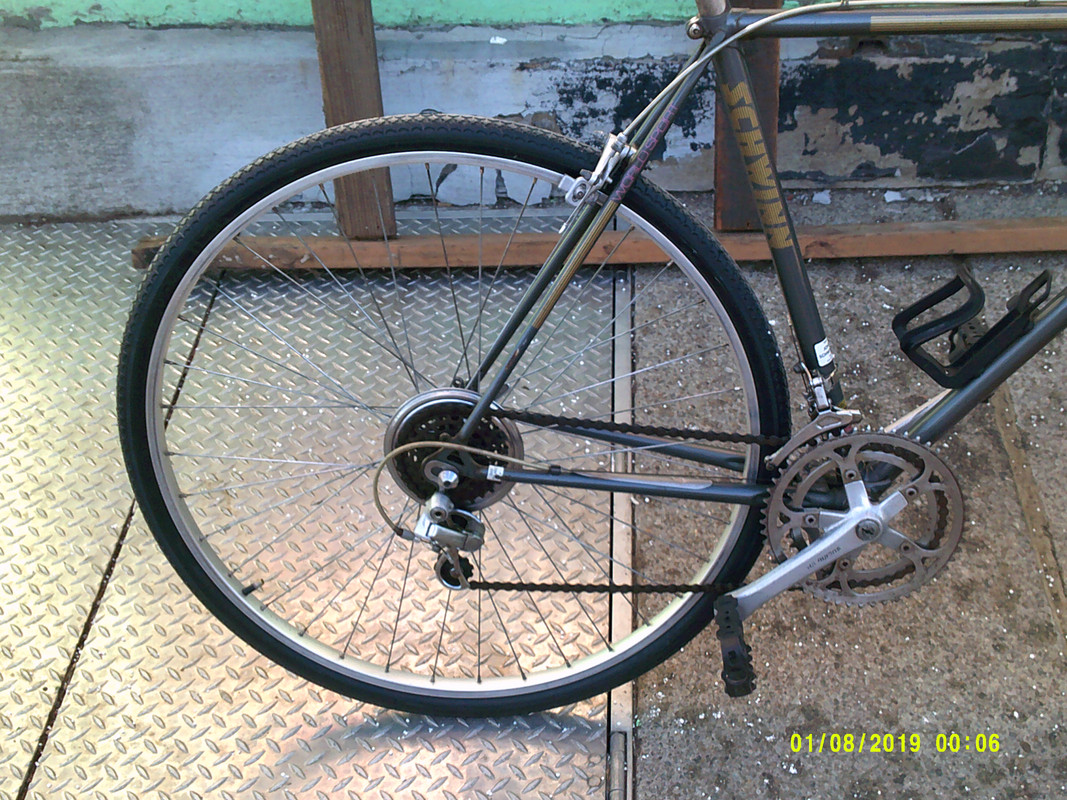
This Schwinn took a while as I had to do some major cleaning on the wheels and other bare metal parts. Once the wheels were clean, I used Scrubbing Bubbles to clean as much dirt off of the frame. This bike did not have brake cables or levers, so I had to install them myself. I replaced the tires and the derailleur cable housings so they matched the housings on the brake cable. After it was reassembled, Carl and I adjusted the derailleurs so that the shifting worked properly. Today, I took it for a ride. It was a bit awkward riding such a tall bike, but I managed to get some good pictures of it.
Over the last week, I was working on this rusty Schwinn. I was able to remove most of the rust using various methods. First, I made a paste from Bar Keeper's Friend and water and applied it to the rims and spokes. after some scrubbing, I wiped it off with a rag and rinsed it with a solution of Dawn dish soap and water. I also tried CLR on the chain rings to remove most of the rust. As a last resort, I sanded off the really stubborn rust before using CLR and a Scotch Bright pad to remove the remaining rust and shine things up a little.
I cleaned the entire bike including the drive train, wheels, and tires using Scrubbing Bubbles before re-assembling the bike. Finally, after pumping up the tires, I gave the entire bike a wipe down with wax trying to avoid the rims. Here are some before and after photographs.
I have noticed that the old traffic lights in Pittsburgh are being phased out and replaced with the ultra-modren, black traffic lights that are found throughout the suburbs. Here is an example of one of the old traffic lights that is still operating at the intersection of Butler St. and McCandless Ave.in Lawrenceville. Take note of the curved gantry that the signal hangs from. and the yellow graffiti-covered controller box on the pole that also used to hold up the overhead cables for the streetcars that used to operate along Butler St.
Sometimes, the signals are just hanging from the wires that power them as these signals below. They are located at the same intersection as in the previous photograph.
One thing to note is the lack of dedicated pedestrian signals.
I think an effort should be made to preserve any of these traffic lights that are still functioning as of today. It is possible to retrofit the old signals with LED light bulbs and new controllers like those used with the SURTRAC system used in other East End neighborhoods. New pedestrian signals and buttons should be used to replace the smaller 3-way signals pointed at the crosswalks.
There is a new bus station in town, Atwood Station. This bus stop previously known as 5th Ave. Opposite Atwood St. is located in Oakland and is one of the busiest in the entire system. Despite it being very busy, it had absolutely no amenities other than the plain blue "BUS STOP" sign marked with the bus routes which service it. The station now includes a large shelter with benches, a Connect Card vending machine, bike racks, as well as a transit map with schedules.